



The right size for a compression vest is the one that matches your chest measurement, not the one that feels tightest. Measure around the fullest part of your chest, use the chart below, and if you land between two sizes, take the larger one. That single rule solves most of the fit problems we hear about.
This guide covers how to measure yourself properly, how to read our size charts, what a compression vest should actually feel like once it is on, how to tell if yours is too tight or too loose, and which of our garments suits which build and situation. It also answers the questions we are asked most often: whether to size down for more compression (no), whether you can wear one every day (yes, with a few sensible limits), and what to do if the first one you order does not fit.
One note before we start. If you are choosing a vest for recovery after gynaecomastia surgery, your surgeon's instructions on what to wear and for how long take priority over anything written here. Use this guide to pick the right size within what they have recommended.
How To Measure Your Chest
All of our vests and shirts are sized on chest measurement alone, so this is the only number you need. It takes about thirty seconds and you will get a more reliable result than guessing from your t-shirt size.
Stand up straight with your arms relaxed at your sides and breathe normally. Wrap a soft tape measure around the fullest part of your chest, across the nipple line, keeping it level all the way round and flat against your back. The tape should be snug against the skin but not pulling in. Read the measurement in inches or centimetres, whichever you prefer, since our charts show both.
Three things people get wrong. Measuring over a shirt adds an inch or more, so measure against bare skin. Pulling the tape tight to get a smaller number does not help, because the chart is built for a relaxed, true measurement. And breathing in and holding it gives you a reading you will never wear the vest at, so breathe out gently and measure at rest.
If you do not have a tape measure, a piece of string or a phone charging cable wrapped round the chest and then laid against a ruler works fine. If even that is not possible, choose one size up from your usual t-shirt size, which is what we recommend on every product page.
Our Size Chart
The same chart applies to our Men's Compression Vest, Adjustable Chest Binder, Firm Compression Zipper Vest, Seamless Compression Shirt, Soft Feel Compression Shirt and Seamless Tall Body Shaper Vest.
| Size | Chest (inches) | Chest (cm) |
|---|---|---|
| M | 36–39 | 91–99 |
| L | 40–43 | 102–109 |
| XL | 44–47 | 112–119 |
| 2XL | 48–51 | 122–130 |
The Max Compression Recovery Vest runs on its own chart because it fastens at the front and covers a wider range of builds.
| Size | Chest (inches) | Chest (cm) |
|---|---|---|
| S | 32–35 | 81–89 |
| M | 36–39 | 91–99 |
| L | 40–44 | 102–112 |
| XL | 45–48 | 114–122 |
| 2XL | 49–52 | 124–132 |
| 3XL | 53–56 | 135–142 |
If you are between sizes
Go up. A 39.5 inch chest is an L, not an M. Compression garments are cut small by design, and the larger of two sizes will still flatten the chest properly while being comfortable enough to wear all day. The smaller size will feel dramatic for the first hour and then start to roll at the hem, dig under the arms, and come off by mid-afternoon.
Do not size down for extra compression
This is the single most common mistake, and it is understandable: if a firm fit flattens the chest, surely a firmer one flattens it more. In practice it does not work that way. The compression comes from the fabric and the panel construction, not from how far it is stretched. Stretch a vest past the size it was cut for and the fabric thins, the panels lose their shape, the seams sit in the wrong place, and the garment wears out in weeks. You get less compression, not more, and you cannot wear it for long enough to matter. If you want firmer flattening, move up to a firmer garment rather than down a size; the comparison further down covers which is which.
What A Compression Vest Should Feel Like
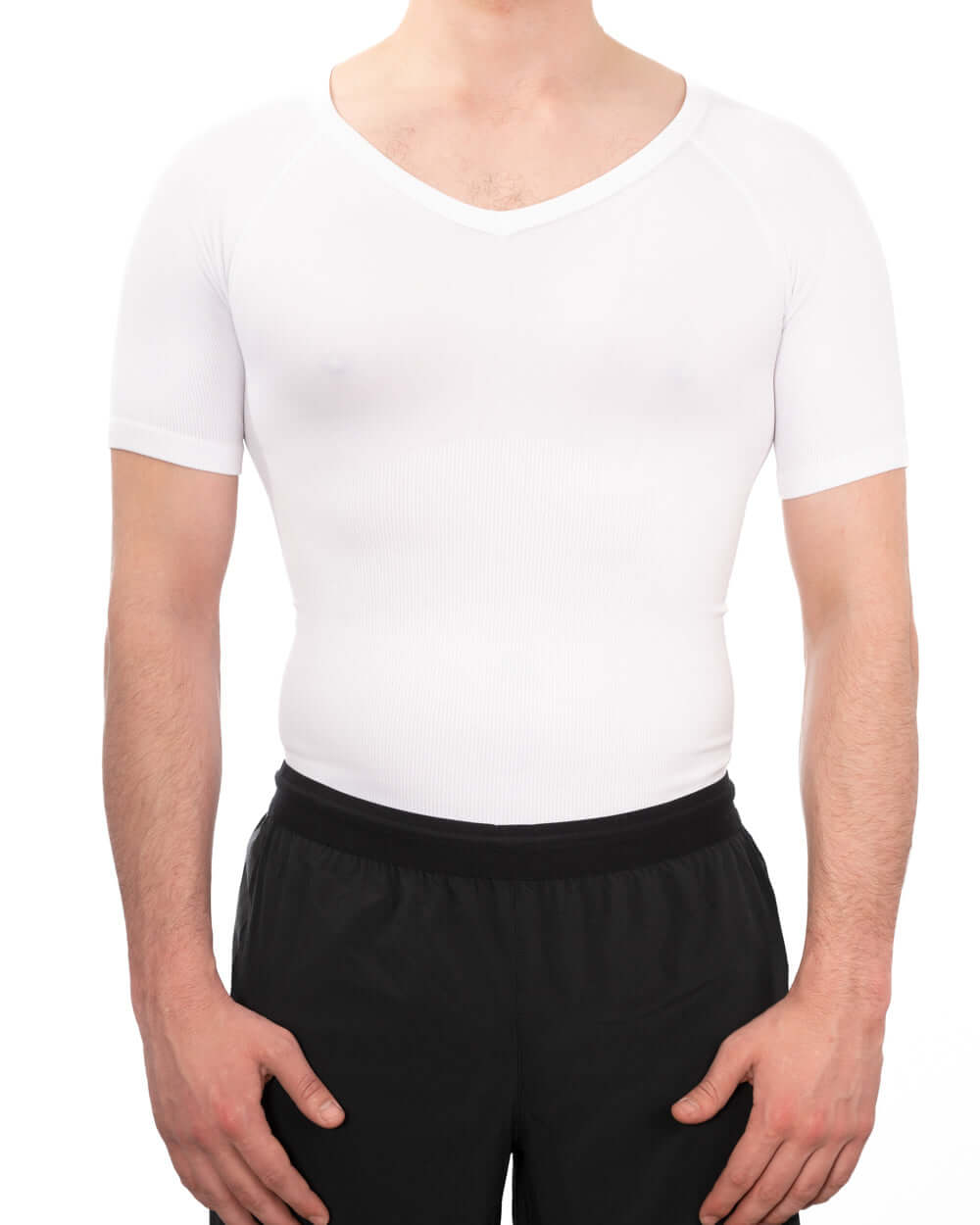
Snug, supported, and after ten minutes, mostly forgotten about. That is the honest target. A correctly sized vest feels firm across the chest and torso when you first put it on, the way a well-fitted swimming jammer does, and then your body adjusts and you stop noticing it. You should be able to take a full, deep breath, raise your arms above your head, sit down, and bend to tie a shoe without the vest fighting you.
Putting it on is the moment most people judge the fit, and it is the wrong moment. Every compression vest is harder to get into than it is to wear. For our pull-on styles we recommend stepping into the vest from the bottom, like shorts, pulling it up to the waist, and then taking one shoulder strap at a time. That is far easier than going over the head and it also gets the panels sitting where they are meant to. Each product page has the full step-by-step.
Signs it is too tight
You cannot take a full breath without feeling the vest resist. There are red marks under the arms or along the hem that are still there an hour after you take it off. The hem rolls up over your stomach, or the shoulder straps dig in. You find yourself taking it off after a couple of hours because you have had enough. Any of those means the next size up, not persistence.
Signs it is too loose
The fabric wrinkles or bunches across the chest rather than lying flat. You can pinch a fold of material away from your body without stretching it. The chest is not noticeably flatter under a t-shirt than it would be without the vest. If the vest is otherwise comfortable, this usually means you measured over clothing or went up a size when you did not need to.
The one-size-up test
If you are unsure which of two sizes you are in, picture wearing the vest for a full working day. If the thought of eight hours in it makes you wince, size up. A vest you can wear all day, every day, does far more for you than one you can only stand for an evening out.
Which Garment Suits You
Size gets the fit right. Choosing the right garment gets the compression level and the convenience right, and those matter just as much. Here is how our range compares.
| Garment | Compression | Fastening | Best for |
|---|---|---|---|
 Men's Compression Vest Men's Compression Vest
|
Moderate to firm | Pull on | Everyday wear, mild to moderate gynecomastia. Our best seller and the right starting point for most people. |
 Seamless Compression Shirt Seamless Compression Shirt
|
Moderate | Pull on, short sleeve | An undershirt that smooths the chest, midsection and love handles. Good for warmer weather and for men who find a vest too firm to start with. |
 Soft Feel Compression Shirt Soft Feel Compression Shirt
|
Gentle | Pull on, short sleeve | The softest fabric in the range, cut as an everyday undershirt with a deep neckline. Choose this over the Seamless Shirt if comfort against the skin matters more to you than smoothing the stomach. |
 Adjustable Chest Binder Adjustable Chest Binder
|
Adjustable, light to firm | Front clasps, three settings | Chest-focused flattening with two layers of fabric. The adjustability makes it forgiving if you are between sizes or your weight changes. |
 Firm Compression Zipper Vest Firm Compression Zipper Vest
|
Firm to very firm | Front zip and clasps | Moderate to more pronounced gynecomastia, and recovery once your surgeon has cleared you for everyday compression. The zip makes it much easier to get on and off. |
 Max Compression Recovery Vest Max Compression Recovery Vest
|
Maximum | Hook and eye, two rows | Our firmest vest, built from 70% nylon / 30% spandex powernet. Front fastening means no reaching overhead, which matters in the weeks after surgery. Sized S–3XL. |
 Seamless Tall Body Shaper Vest Seamless Tall Body Shaper Vest
|
Moderate | Pull on | Taller builds, or anyone who finds standard vests ride up. Extended torso length covers the stomach and love handles as well as the chest. |
A simple way to choose: if you mainly want the chest flatter under a t-shirt and you have not worn compression before, start with the Men's Compression Vest in your measured size. If you want the firmest possible result, or you are recovering from surgery, choose the Zipper Vest or the Recovery Vest, which both fasten at the front. If you want something you barely notice, the two shirts are the gentlest options: the Seamless Compression Shirt if you also want the stomach and love handles smoothed, the Soft Feel Compression Shirt if softness against the skin is the priority. If you are over about six feet or have a long torso, the Tall Body Shaper is cut for you.
Sizing For Post-Surgery Wear
Compression after gynaecomastia surgery is usually worn in two stages: the garment your surgeon provides for the first week or two, and then a firm everyday vest for the weeks after that. Our post-surgery collection covers the second stage.
Measure for it the same way, with two cautions. Measure before surgery if you can, since swelling in the first weeks can add an inch or two that will go down. And choose a front-fastening style, because pulling a firm vest over your head is exactly the movement you will be told to avoid. The Max Compression Recovery Vest has two rows of hooks so you can loosen it as swelling settles, and the Zipper Vest does the same job with a zip.
Our week-by-week recovery guide goes into when most surgeons allow the switch from the post-operative garment to everyday compression, but the timing is always theirs to set.
Wearing It Every Day
All of our vests and shirts are designed for daily wear, and most of our customers wear one most days. A few sensible limits keep that comfortable.
Give your skin a break overnight. There is no need to sleep in a compression vest unless your surgeon has told you to, and your body will thank you for the eight hours out of it. Take it off for intense exercise unless you are wearing a style designed for it; firm compression and heavy breathing do not go together, and sweat trapped against the skin for a long session is how rubbing starts. In hot weather, the Seamless Compression Shirt is the most breathable option and is the one we would reach for first.
Wash it cold and let it air dry. Heat is what kills elastane, so a hot wash or a tumble dryer will take the compression out of a vest faster than months of wearing it. With cold washing and air drying, a vest holds its shape well. If you are wearing one daily, two in rotation last far longer than one worn and washed every day.
If Your First Order Does Not Fit
It happens, and it is why we keep returns simple. Unworn items in their original condition can be returned within 30 days for an exchange or refund, so if you have measured carefully and the size still feels wrong, send it back and we will swap it. Full details are on our returns page.
Before you do, try it on properly. Put it on from the bottom up, smooth it flat, and wear it around the house for twenty minutes. A vest that feels alarming in the first two minutes very often feels right by the twentieth. If it still fails the full-breath and raised-arms test after that, it is the wrong size, and the next size up is almost always the answer.
Common Questions About Sizing
How tight should a compression vest be?
Snug and firm across the chest, but you should still be able to take a full, deep breath, lift your arms above your head and sit comfortably. If any of those is a struggle, or you have marks under the arms an hour after taking it off, it is too tight and you need the next size up.
Should I size down for more compression?
No. The compression comes from the fabric and the panel construction, not from how far it is stretched. Sizing down thins the fabric, moves the panels off the chest, causes rolling and digging, and shortens how long you can wear it. For firmer flattening, choose a firmer garment at your true size instead.
What if I am between two sizes?
Take the larger size. It will still flatten the chest properly and you will be able to wear it all day. If you are between sizes and want something forgiving, the Adjustable Chest Binder's three clasp settings and the Recovery Vest's two rows of hooks both let you fine-tune the compression after you have bought.
Do your sizes run small?
They are cut to the chest measurements in the chart and fit true to those measurements. They will feel smaller than a normal t-shirt in the same letter size, because they are meant to; that is the compression. Measure your chest rather than going by your t-shirt size, and if you cannot measure, choose one size up from your usual t-shirt.
Can I wear a compression vest every day?
Yes. Our vests and shirts are made for daily wear. Take it off overnight, swap it for something lighter during intense exercise, wash it cold and air dry, and keep two in rotation if you wear one most days.
Which size do I need after gynecomastia surgery?
Your measured chest size, ideally measured before surgery since swelling can temporarily add an inch or two. Choose a front-fastening style so you are not pulling a firm vest over your head, and follow your surgeon's guidance on when to move from the post-operative garment to everyday compression.